KLOW
KLOW peptide half-life at Peptide R Lab
Four ingredients share a preparation. Their time in the body has never been measured as a blend.
KLOW peptide half-life
There is no validated human KLOW peptide half-life to report. The four-peptide mixture has no controlled study establishing its pharmacokinetics, safety or efficacy. Calculating a blend half-life from its ingredients would conceal the missing experiment.
BPC-157’s under-30-minute elimination half-life came from rats and dogs. KPV has no validated human half-life, and the human thymosin beta-4 trial used the full-length protein rather than the TB-500 fragment. These are different materials in different settings.
Before I get excited about KLOW, I want measurements of how much of each component survives mixing, followed by exposure over time. Complementary proposed mechanisms cannot answer either question.
Four ingredients by mass
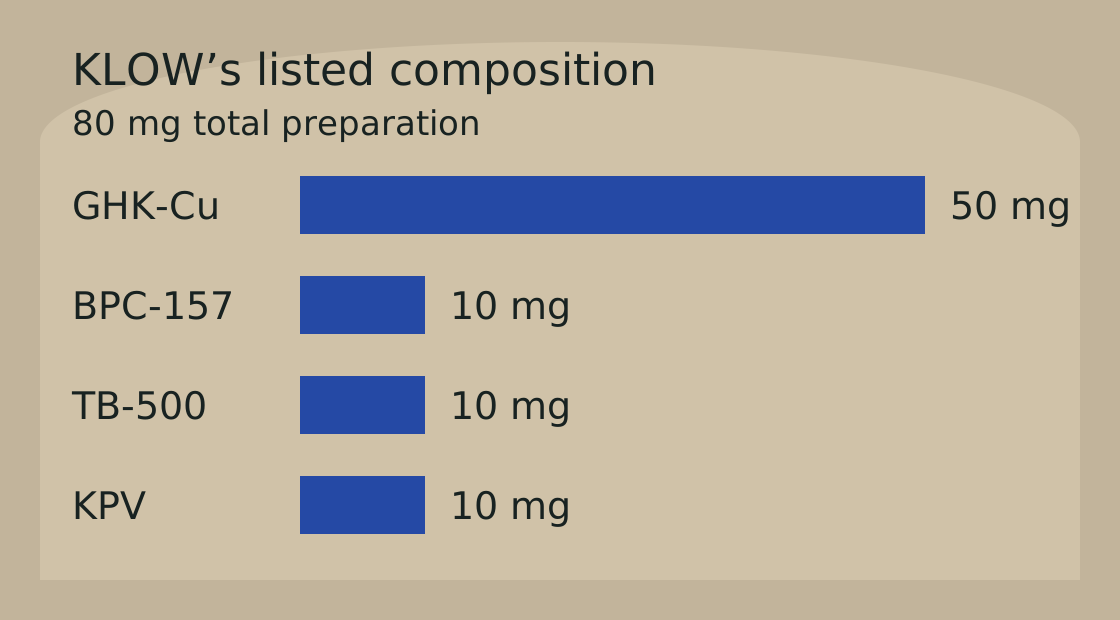
KLOW is a co-formulation of GHK-Cu, BPC-157, TB-500 and KPV, supplied together as separate molecules. A commonly listed preparation totals 80 mg: GHK-Cu 50 mg, BPC-157 10 mg, TB-500 10 mg and KPV 10 mg. These figures describe a research preparation’s composition, never an amount for a person.
GHK-Cu carries copper and dominates the preparation by mass. That is where my mixture questions begin. A shared container says little about whether the ingredients remain stable together or reach tissue together.
KLOW lab tested: COA and test report
“KLOW lab tested” can describe an analytical claim about a sample. A certificate of analysis, or COA, needs to identify the material and the measurements it reports. A claim about purity alone leaves other questions open, including the identity and amount of each component, mixture stability and any testing for contamination.
I would want to see the actual report before judging the phrase. This site has no batch-specific KLOW test report to authenticate. It also has no controlled blend experiment to cite. The test-report questions cover the same distinction for BPC-157 + TB-500 + KPV and BPC-157 + KPV preparations.
Studies of the separate ingredients
The GHK-Cu skin-regeneration review describes topical human and cell-culture work, including collagen and other matrix components. The gene-expression review describes changes in gene activity in cell-culture and database analyses. The BPC-157 human pilot examined tolerability in two adults. KPV’s PepT1 study concerns cultured intestinal and immune cells and mouse colitis.
These findings explain the interest in a blend. They also show how much assembly is happening in the claim itself: skin applications, intravenous safety observations and gut experiments are being asked to support one mixture. I cannot locate a controlled comparison of KLOW against its individual ingredients, a subset or placebo.
Copper, compatibility and safety
Copper chemistry creates a theoretical compatibility question when GHK-Cu is co-dissolved with the other peptides. Copper-handling disorders, including Wilson’s disease, also raise a specific theoretical concern; the GHK-Cu review describes the copper-binding component, while clinical evidence about this blend in those conditions is missing.
The KPV inflammatory-signaling work raises questions about immune modulation during infection or autoimmune disease. Pro-angiogenic component findings raise a theoretical cancer concern. None establishes a measured human risk for KLOW. The 2026 sports-medicine review is more restrained than the blend’s reputation: favourable animal outcomes accompany scarce rigorous human safety data and potential for serious harm.
KLOW has no FDA approval. Its TB-500 component implicates WADA’s prohibition. Community stories include less pain, improved gut comfort and smoother-looking skin, alongside local reactions, fatigue, headache, nausea or no noticeable change. Those anecdotal accounts cannot identify which ingredient caused a change, and they provide no clinical evidence for the blend.